The Right Balance by Hugh Segal
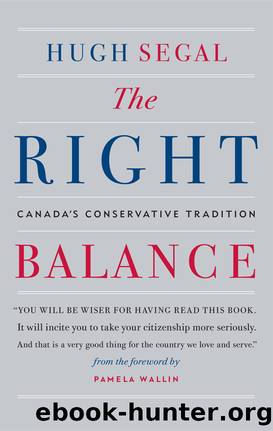
Author:Hugh Segal
Language: eng
Format: epub
Tags: POL042020
ISBN: 9781553657903
Publisher: Douglas and McIntyre (2013) Ltd.
Published: 2011-03-15T00:00:00+00:00
[ 7 ]
RED TORY PRAIRIE
POPULISM AND
MR. DIEFENBAKER
The more populist side of ânation and enterpriseâ would come from the leadership of John George Diefenbaker. In 1956, when the Progressive Conservative Party chose Diefenbaker to take the party forward, it stepped firmly outside the Toronto circle to embrace a populist who had tried to win the leadership before and who had been rebuffed many times in Saskatchewan before winning Prince Albert in 1940. And Mr. Diefenbaker would take on the leadership at a time when the Liberals, in a postwar economic and victorious blush, seemed simply undefeatable, when the central government-business partnerships made large industry and government each othersâ primary clients and key de facto shareholders. In essence, the war effort had fused corporate and private into one massive government-industry consortium, as wars often do. This was not ânation and enterprise.â This was nation and enterprise as each otherâs âsubsidiary,â with no serious accountabilities for either. But what this Liberal corporatist approach meant for the future was more problematic, especially because the war had been over for a decade.
The end of World War II, the selection of George Drew as national Progressive Conservative leader after his successful government service to Ontario, the succession of Liberal Louis St. Laurent from minister of external affairs to prime minister in 1948, spoke to some changing of the guard in national politics. But the change in our political masters was really trailing far behind the changes in Canadian society. In fact, we wouldnât begin to catch up until 1958. And, as I have argued from the very first chapter, ideas and political philosophies do not change the geography, demographics or ethnicity of a society. It is profoundly and clearly the other way around. And the core changes that the end of World War II would bring to Canada would not only change the generic makeup of Canadian politics, but greatly affect the character and reach of Canadian conservatism.
The nature of the war effort had greatly empowered women, who stepped up to occupy the industrial jobs left vacant by the men who had gone to war. Large and expansive female naval, army and air force membership served and supplemented the war effort in a host of vital ways. At the same time, the concentrated development of aerospace, armament and related munitions industries once again turbo-charged the forces of urbanization, increasing the pull of people away from the rural and agricultural communities.
The returning veterans and the growing demand around the world for Canadian natural resources and manufactured commodities such as steel and aluminum quickly began to inject new life into the economy. By the end of the 1950s, positive cash flow from exports and related royalties began to pour into government. But there was another sea change as well; a sea change that cut right across Canada, the United States, the United Kingdom, Australia and other Western countries. It was a product of the attitudes of the surviving and burgeoning postwar population and their experience of the war itself.
Download
This site does not store any files on its server. We only index and link to content provided by other sites. Please contact the content providers to delete copyright contents if any and email us, we'll remove relevant links or contents immediately.
| Arms Control | Diplomacy |
| Security | Trades & Tariffs |
| Treaties | African |
| Asian | Australian & Oceanian |
| Canadian | Caribbean & Latin American |
| European | Middle Eastern |
| Russian & Former Soviet Union |
The Secret History by Donna Tartt(19083)
The Social Justice Warrior Handbook by Lisa De Pasquale(12190)
Thirteen Reasons Why by Jay Asher(8907)
This Is How You Lose Her by Junot Diaz(6885)
Weapons of Math Destruction by Cathy O'Neil(6279)
Zero to One by Peter Thiel(5800)
Beartown by Fredrik Backman(5751)
The Myth of the Strong Leader by Archie Brown(5507)
The Fire Next Time by James Baldwin(5441)
How Democracies Die by Steven Levitsky & Daniel Ziblatt(5218)
Promise Me, Dad by Joe Biden(5153)
Stone's Rules by Roger Stone(5087)
A Higher Loyalty: Truth, Lies, and Leadership by James Comey(4959)
100 Deadly Skills by Clint Emerson(4924)
Rise and Kill First by Ronen Bergman(4788)
Secrecy World by Jake Bernstein(4751)
The David Icke Guide to the Global Conspiracy (and how to end it) by David Icke(4717)
The Farm by Tom Rob Smith(4506)
The Doomsday Machine by Daniel Ellsberg(4490)
